7 Teacher Outfits That Survive a Full School Day
Teacher outfits that handle standing, bending and parent meetings without falling apart. Seven combinations built around published dress code guidance for educators.
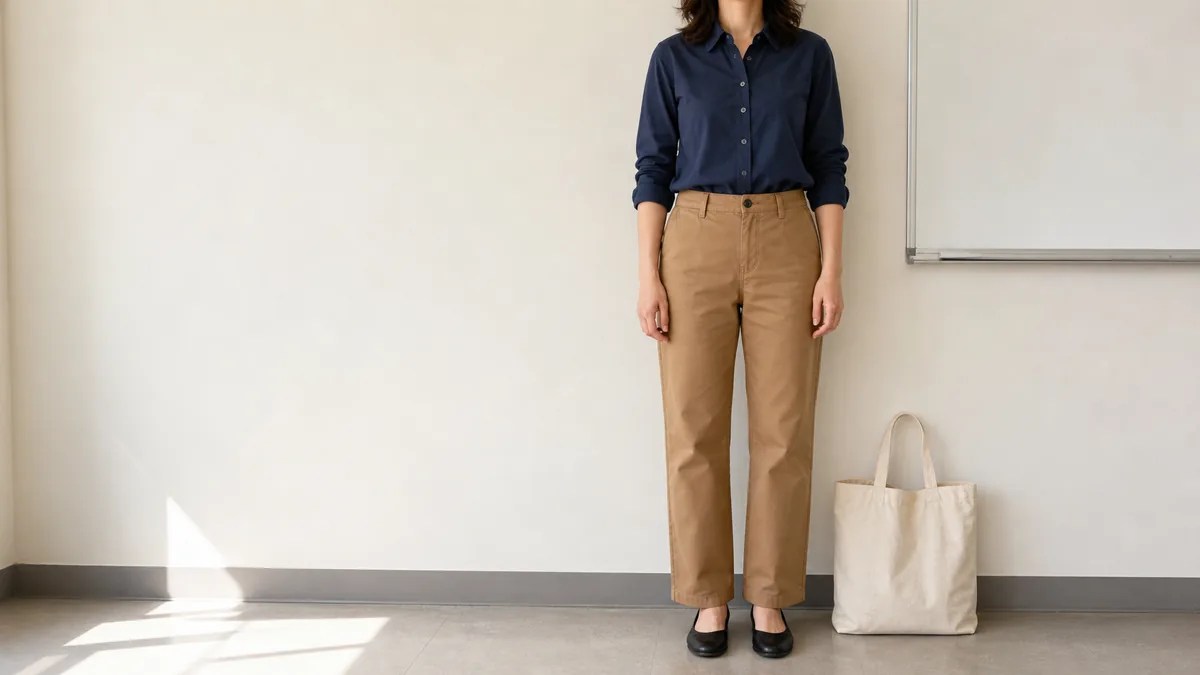
Working out an outfit for tomorrow? Save this page. It is easier to skim the night before than to remember.
At a glance
Works
- A collared shirt with straight-leg slacks, the pairing on nearly every published list
- A knit blazer over a shell on parent-facing days
- A midi dress with pockets and flats, hem checked seated
- A fine-gauge cardigan over a clean crew neck
Depends
- Athletic wear, only on PE days, field days and playground duty, kept tidy
- Joggers and tees, common in elementary rooms and out of place in most high schools
- Low heels, allowed in guidance, but weigh them against six hours standing
Skip
- Running shoes, plastic sandals and flip flops on ordinary teaching days
- Loose graphic tees, even under a cardigan
- Anything that gapes or rides up when you bend over a desk
Teaching is one of the few jobs where your clothes have to do three things at once: meet a dress code, survive six hours on your feet and look put together when a parent walks in. Most office advice ignores the second and third parts.
These seven outfits are built around published guidance for educator appearance. The dress code facts come from the sources listed at the bottom. The styling choices are judgment, and they are labelled as such.
1. Straight-leg trousers and a collared shirt, the baseline that passes everywhere
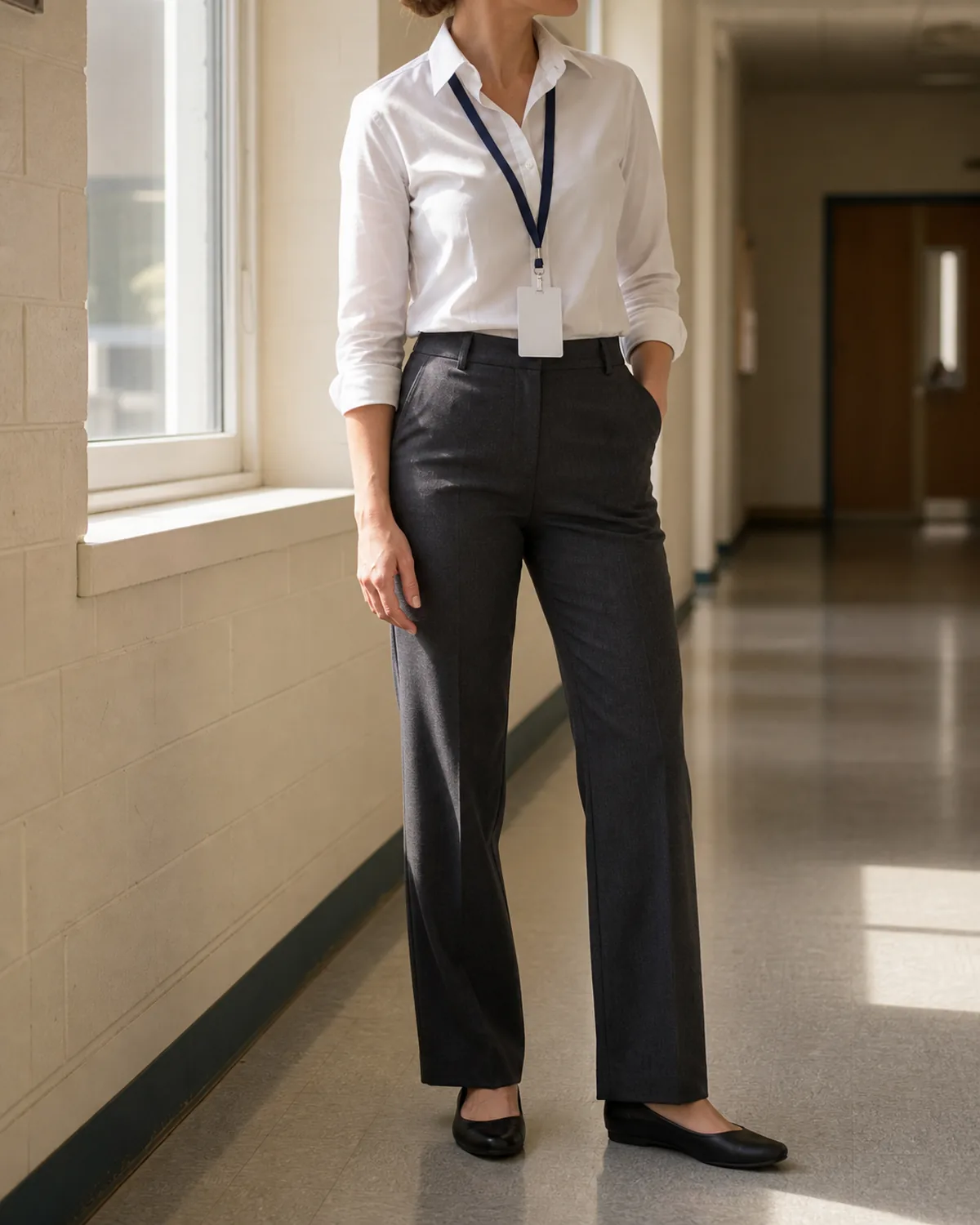
Collared shirts and slacks appear on almost every published list of acceptable teacher attire. Georgia Southern's educator guide names them directly, and Indeed's dress code overview lists button-down shirts and wool pants or slacks as standard. If you own nothing else from this page, this combination passes nearly any school district.
The rolled sleeve is a deliberate choice. Teaching involves reaching, writing on a board and crouching next to a desk, and a cuff that needs adjusting every ten minutes is not practical. Rolling to the forearm keeps the shirt looking intentional rather than dishevelled.
- Press the shirt the night before; guidance names wrinkle-free specifically
- Keep the trousers straight-leg rather than wide, so the break at the shoe is clean
- The lanyard is not optional in most buildings, so choose one that sits flat
- Replace the shirt once the collar starts yellowing; that reads as worn, not relaxed
2. A knit blazer over a shell, for the day you meet parents
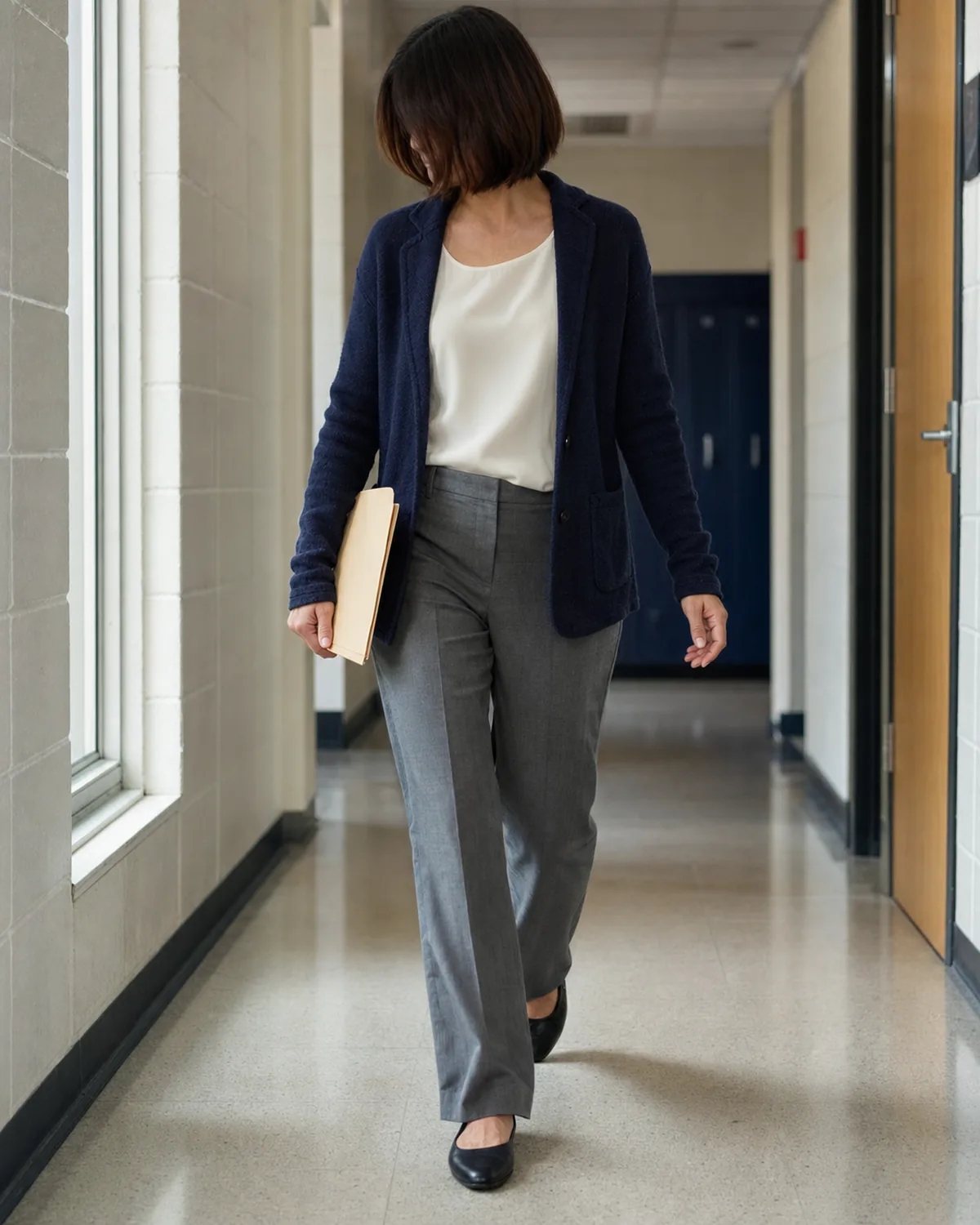
Students have told researchers that teachers serve as role models, and that they want to see what professional looks like in the workplace. Parent-teacher nights and open-house days are when that observation sharpens. A knit blazer over a shell is the fastest way to step the baseline up without losing the ability to move.
The knit matters. A structured wool blazer restricts the shoulder when you reach above your head, and teaching involves a lot of reaching. An unstructured knit holds a clean lapel line but gives at the elbow and shoulder, which means you do not have to take it off the moment you walk back into the classroom.
- Keep the shell simple; the blazer is carrying the formality
- Choose a blazer with patch pockets rather than welt, so you have somewhere for a pen
- Wear it open, not buttoned, so you can move between desks without adjusting
- Educator guidance suggests avoiding bulky jewellery that could distract learners
Where to start
Find your situation, skip ahead
It is your first week and you cannot read the school yet
Err formal for two weeks, watch your department on an ordinary Wednesday, then adjust.
01 Straight-leg trousers and a collared shirt, the baseline that passes everywhere07 What your school actually means by "professional"
Parent-teacher night is on the calendar
Step the baseline up one notch and keep your arms free; the knit blazer exists for exactly this.
You are furnishing a teaching wardrobe on a first-year salary
Buy the five-piece formula first; it makes a working week before anything else does.
04 The cardigan-and-ankle-trouser formula that repeats all week05 Closed-toe flats and why they are not optional
3. A midi dress with flat shoes and pockets
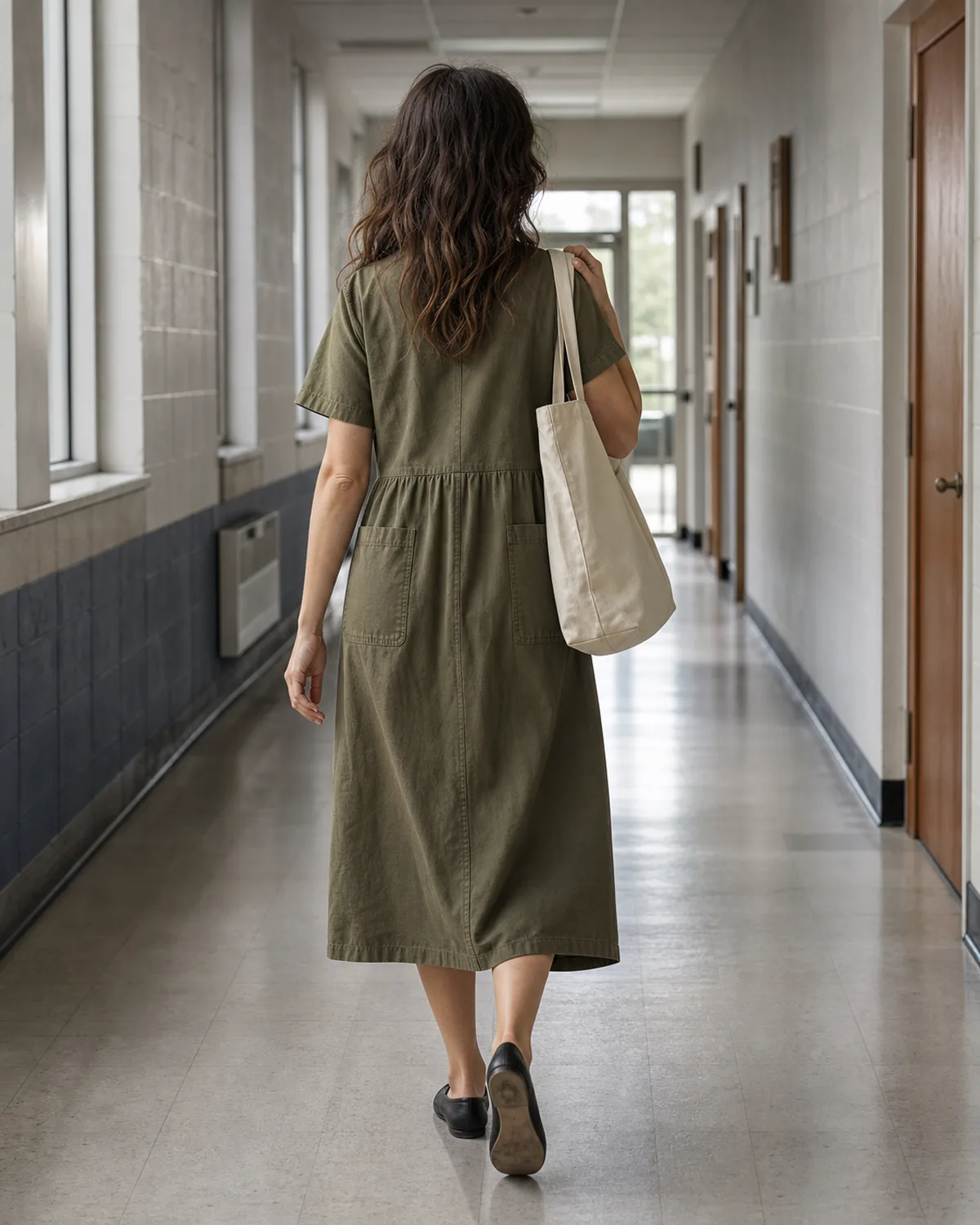
A dress is the fastest outfit decision because there is only one piece to choose. Published guidance lists dresses and skirts no shorter than two inches above the knee as acceptable, which makes a midi length the safest default.
The pockets are not a styling detail. Teachers carry whiteboard markers, hall passes, a phone and sometimes a timer. A dress without pockets means a bag on your shoulder all day, and a bag on your shoulder while bending over a desk is a dress code problem waiting to happen. Educator guidance specifically notes that clothing should not be revealing when bending or reaching.
- Choose a cotton or a cotton blend so it does not cling after a warm afternoon
- Check the hem seated, not just standing; a midi that rides up past the knee when you sit at a low table has changed its formality level
- Flat shoes are enough; the dress does the work
- Patch pockets sit flatter than side-seam pockets and hold a marker without bulging
4. The cardigan-and-ankle-trouser formula that repeats all week
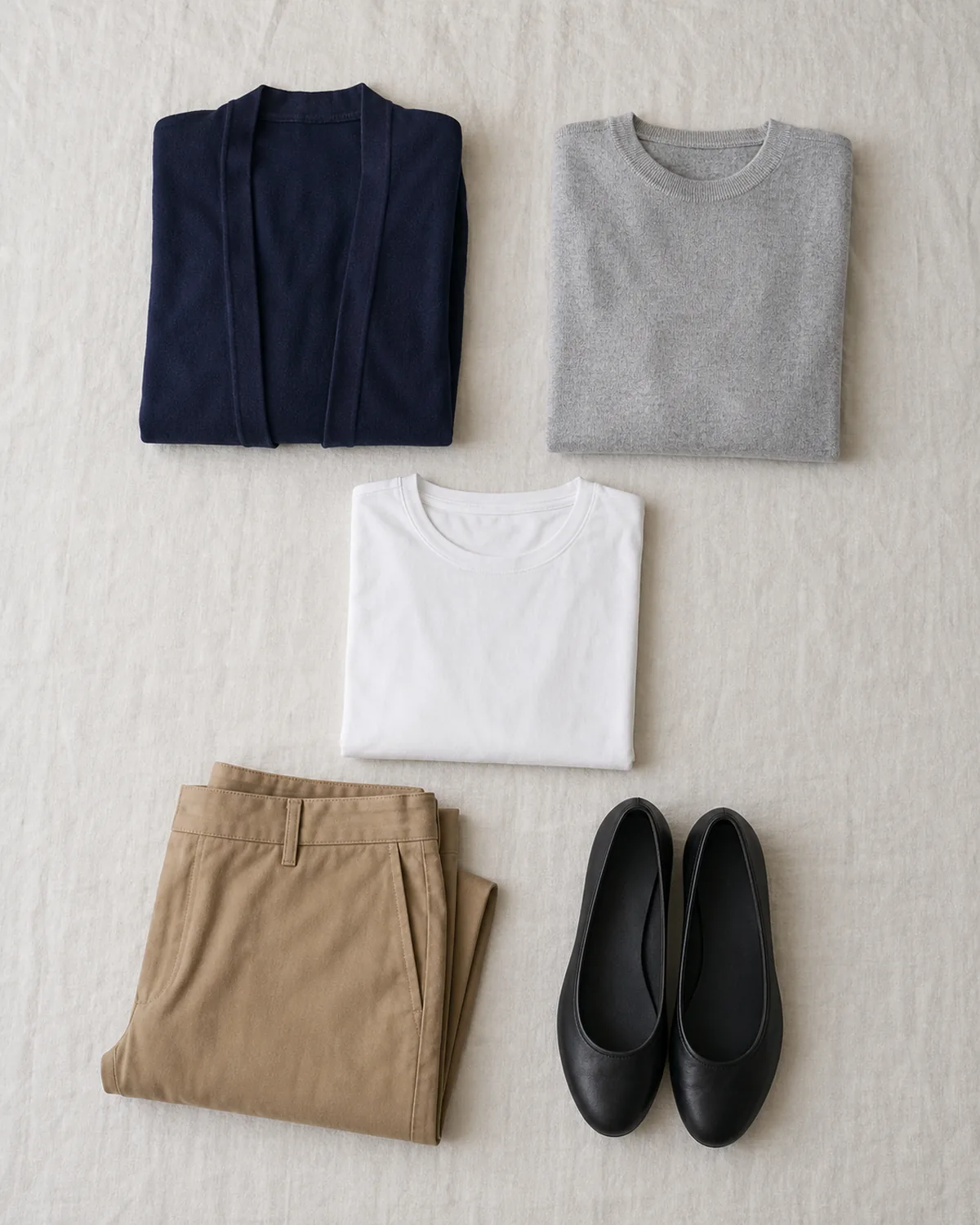
Five pieces, three tops and one bottom and one shoe, make at least five distinct outfits. That is a working week from a carry-on bag, which matters if you are a first-year teacher furnishing a wardrobe on a first-year salary.
Cardigans are named in dress code guidance as acceptable tops. The trick is in the weight. A fine-gauge knit holds a vertical line down the front that reads as structured, while a chunky knit reads as weekend. Pair the cardigan with the plain t-shirt on an ordinary day and swap in the crewneck knit when you want a slightly sharper line.
- Ankle trousers work better than full-length in warm classrooms
- The t-shirt must be a crew-neck in good condition; guidance names tee shirts as generally excluded, but a clean, fitted crew under a cardigan reads differently from a loose graphic tee
- Build around one trouser colour and two neutral tops so every combination works
- Replace the flats when the toe starts scuffing; published guidance says shoes must be clean and polished
5. Closed-toe flats and why they are not optional
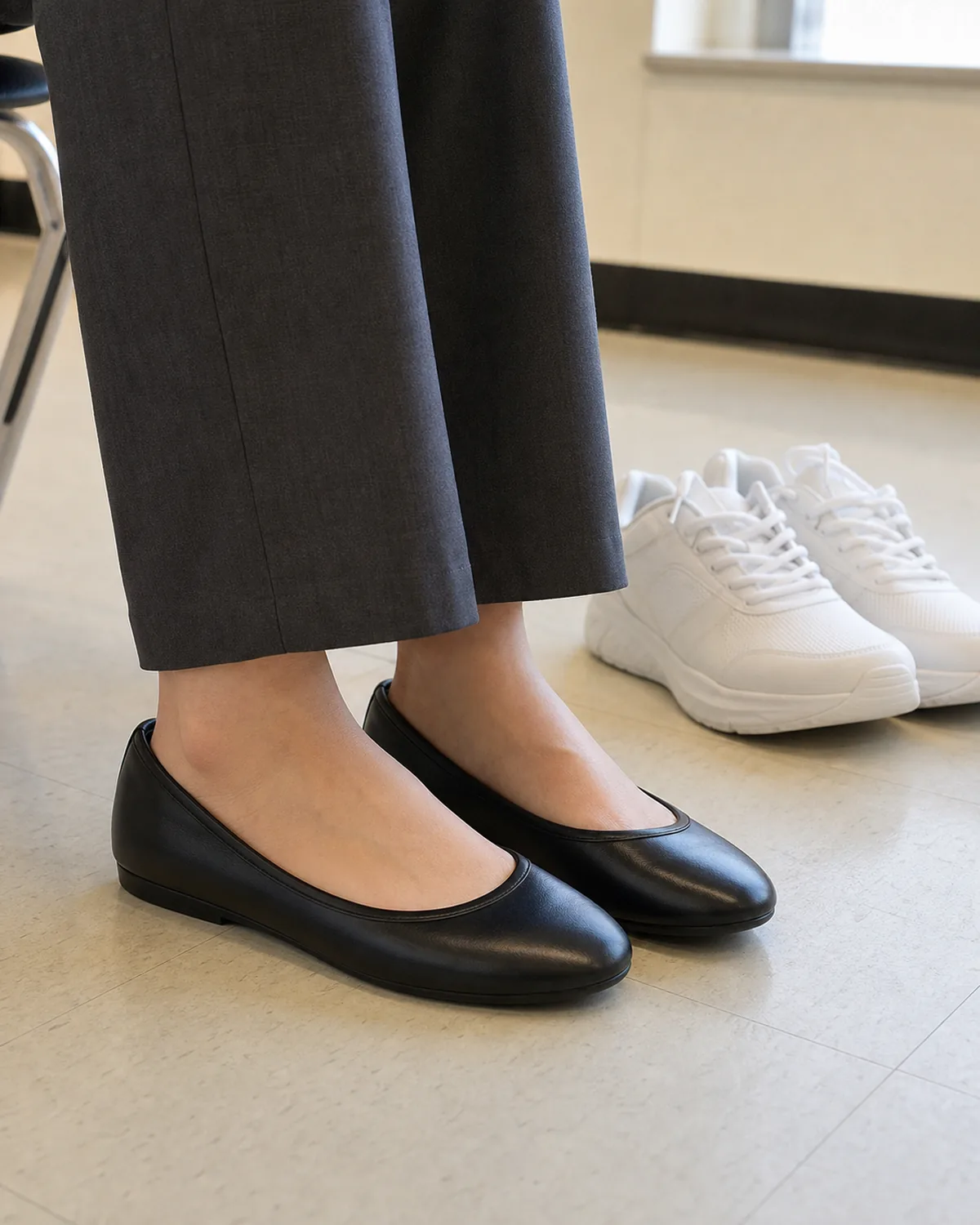
Georgia Southern's guide for educators names the exclusion list explicitly: athletic wear in general, running shoes, walking shoes, cross trainers, house shoes, deck shoes, slippers, shower shoes, plastic sandals and flip flops. What remains is closed-toed shoes with backs.
The sneakers in the background are there to make the point visually. On an ordinary teaching day they do not belong, even if they are more comfortable. The exception is the PE day covered in the next section. Outside of that, a leather flat with a closed toe and a back is the lowest-maintenance shoe that passes every published standard.
- Choose a flat with a slight structure at the heel counter so it does not collapse
- Keep them polished; Indeed's guidance notes shoes should be clean and polished with no scuff marks
- A pointed flat reads slightly more formal than a round toe, which can matter if your school trends formal
- Low heels are mentioned as appropriate, but educator guidance also notes comfort during long days on your feet
6. The PE-day exception: when athletic wear is the dress code
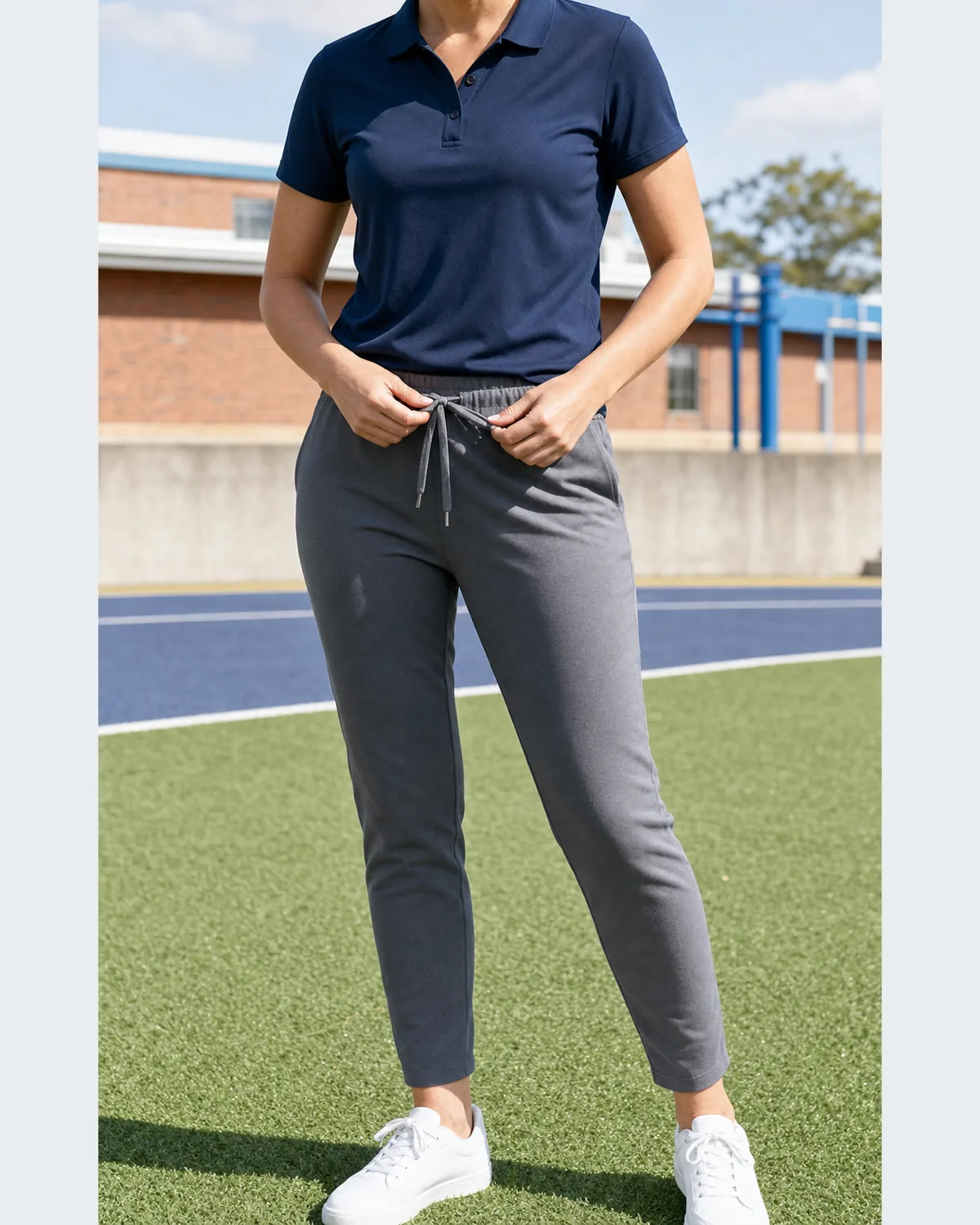
Physical education teachers are specifically allowed athletic apparel. Indeed's guidance notes that this includes tracksuits and performance shirts, because the physically demanding nature of the subject requires safety and mobility. Field day, playground duty and PE coverage fall under the same logic.
What separates acceptable athletic wear from the kind that appears on the exclusion list is tidiness. The polo in this image is fitted, not baggy. The joggers are tapered, not relaxed-fit sweatpants. The trainers are clean. If you walked from the field into a parent meeting, no one would question whether you dressed professionally for the activity you were doing.
- Keep PE-day clothes separate from your weekend workout gear
- A performance polo reads more professional than a t-shirt with the same effort
- Tapered joggers hold a cleaner line than straight-leg sweatpants
- Wash and replace them on the same cycle as your regular work clothes
7. What your school actually means by "professional"
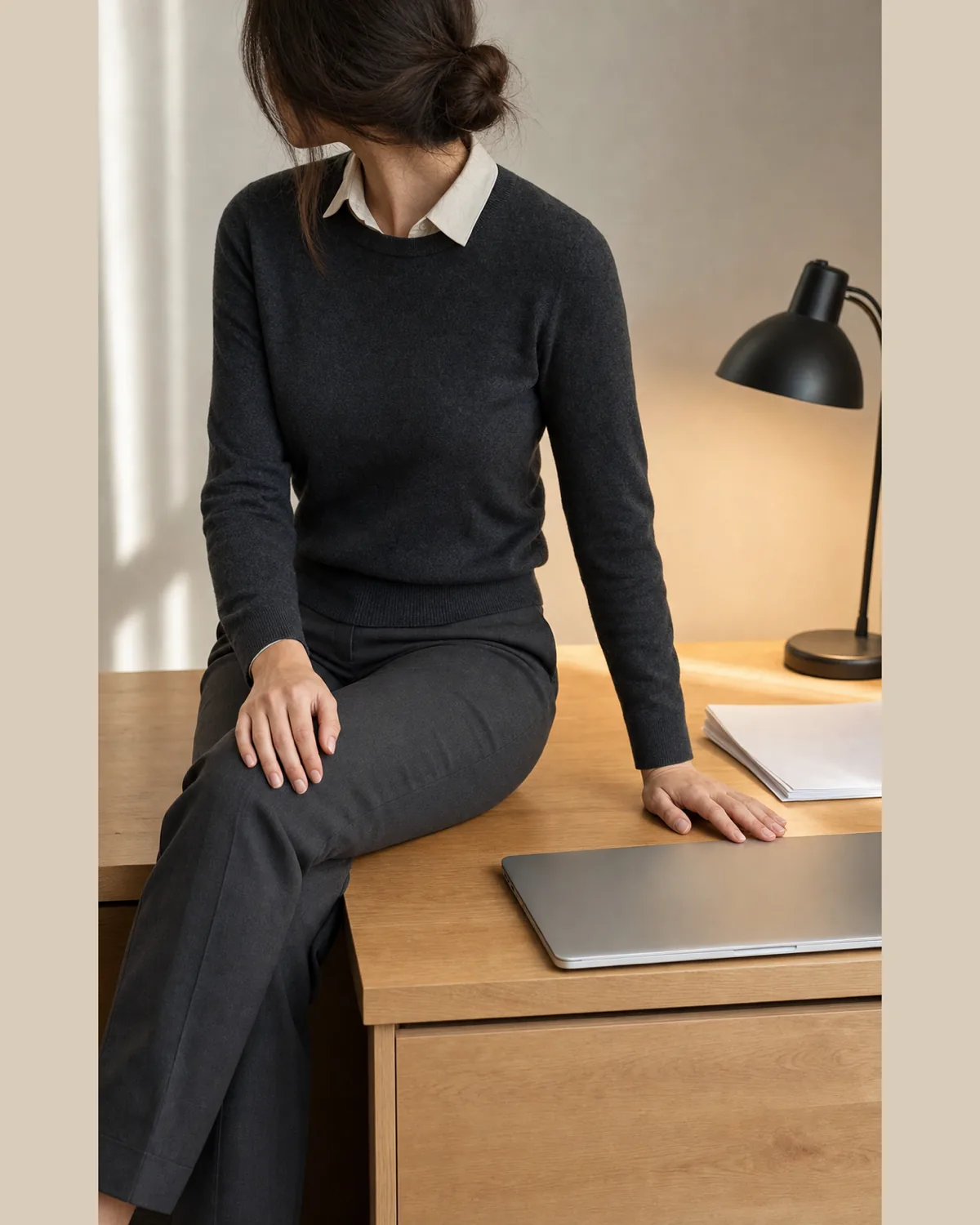
There is no single national standard for teacher dress. Education Week reports that elementary teachers commonly wear comfortable clothing like joggers and t-shirts to participate in physical activities, while high school teachers dress increasingly more formally because, as one superintendent put it, students notice.
That split is worth knowing before you dress for your first day. What counts as professional in a kindergarten classroom and what counts as professional in a high school English department are not the same outfit, even in the same district.
The published opinions themselves disagree. One educator quoted by Education Week calls dress codes very outdated and way too conservative. Another says educators should be professionals in all aspects, including dressing for working. Both positions exist, and your school's culture will tell you which one applies.
- Read the written dress code first; it outranks anything here
- Look at what people in your department wear on an ordinary Wednesday
- If you are new, err formal for the first two weeks, then adjust
- If your school has spirit days or casual Fridays, those exceptions are usually named in the handbook
If your school's dress code overlaps with a general office standard, the business casual guide covers that shared territory in more detail. But teaching adds constraints that a standard office does not have, and those constraints are the reason every outfit on this page was chosen for durability and movement first, and appearance second.
Where the dress-code definitions come from
- The Evolution of Teacher Dress Codes: Adapting to Online Learning — Indeed
- What Does It Mean for Teachers to Dress 'Professionally'? — Education Week
- Professional Appearance for Educators — Georgia Southern University Libraries
Keep this one
Save it where you plan outfits
Pin the image above to the board you actually check on a Sunday night. This guide is written to be re-read, not read once.
Tonight, before you close this tab
- Hang tomorrow's outfit tonight, pressed, so the morning is a zero-decision start
- Crouch and reach once in tomorrow's outfit, in front of no one
- Check your flats for scuffs and give them thirty seconds of polish
- Drop a whiteboard marker and a spare hair tie into tomorrow's pocket or tote